Nia Groce
October 19th, 2026
Breaking the (Skin) Barriers
Harrison Alcock ran out of room on skin, so he built an industry on leather instead.
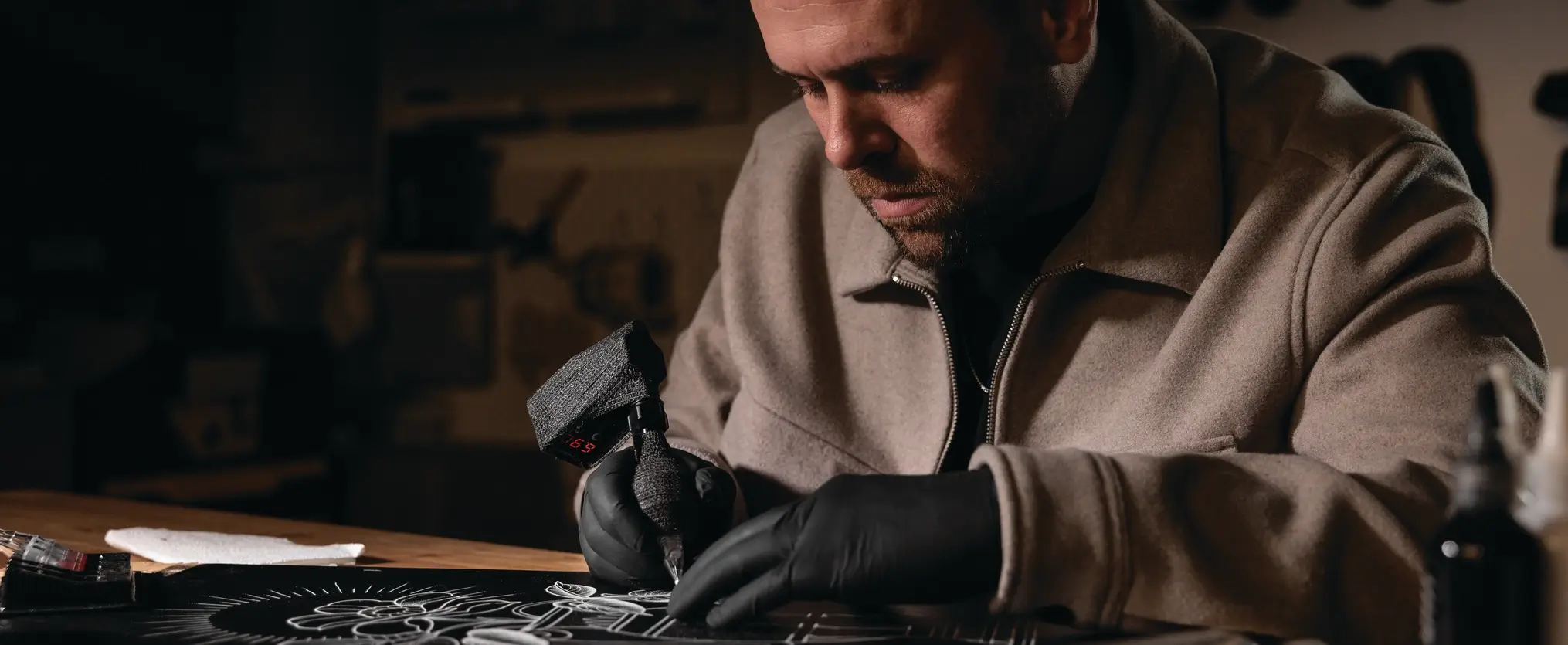
The needle doesn’t know the difference. Leather, Harrison Alcock will tell you, is the nearest thing to living skin — close enough that a tattoo machine can’t feel the switch and that the ink still needs to earn its place. What it lacks is a client attached to it. And for the founder of Artimus Ink, that absence changed everything.
Before shoes, supercar interiors, and NDA-bound projects with major brands, Alcock spent a decade as a traditional tattoo artist. It was, by his own account, a career he loved until he didn’t. “I think I kind of got to a part where the market was oversaturated and falling out of love with tattooing as a whole, which was such a sad moment for me,” he says. “That was my career.”
The problem wasn’t the craft. It was the ceiling above it — a client-dependent industry, increasingly crowded, in a moment he describes as undoubtedly digital. “I knew that we were in a digital era now. So whether I like it or not, I have to change something about my process, or nothing will change.”
OBJECTS OF AFFECTION
Long before leather entered the picture, Alcock’s relationship to objects — specifically, to shoes — had already been in motion. He started skateboarding around 8 years old and stayed on a board into his early 30s, until injuries forced him off. Skateboarders tend to burn through shoes without much sentiment, but for Alcock, watching pair after pair get destroyed only deepened his fascination with them.
“You go through shoe after shoe after shoe. You’re ripping them and you lose the emotional attachment and the love for shoes because you know they’re going to get ruined,” Alcock says. Skating was one half of his life. Tattooing, eventually, became the other. The idea of fusing them — putting a needle to a product instead of a person — wasn’t a market strategy so much as an inevitability. “It just seemed right to put them both together.”
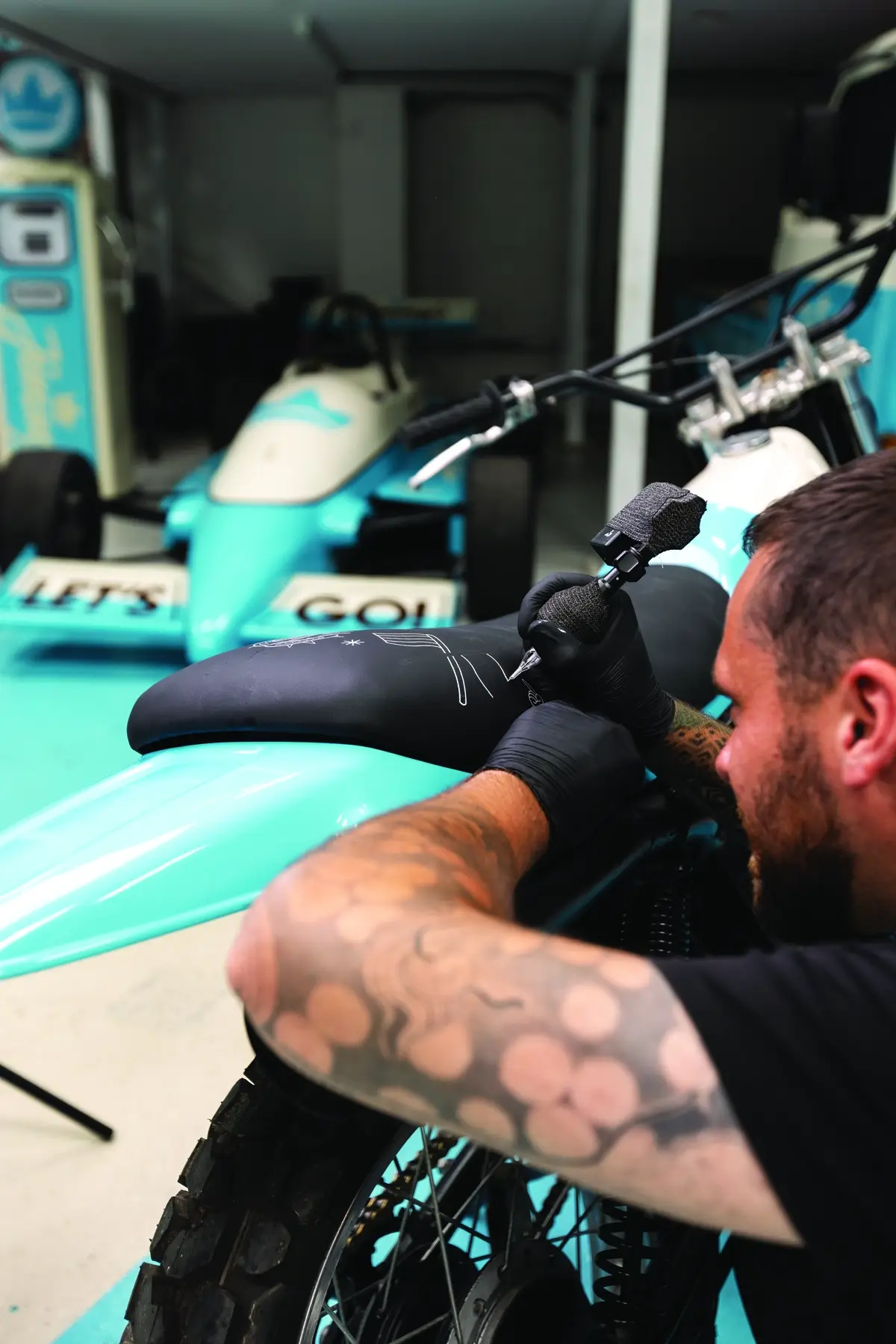
Once he landed on leather, the choice of material had its own particular logic. Thin fabrics couldn’t survive contact with a tattoo needle pulsating at speed. Suede, calico, anything delicate would simply tear, but leather could take it. “Leather is the nearest thing to skin,” he explains, “so I thought that was the best object to take.”
Knowing leather could hold a tattoo and knowing how to make one that lasted were two different problems, and there was no rulebook to consult. Earlier attempts by others in the space, Alcock says, had produced work that degraded the material almost on contact, particularly with color. “It would ruin the leather. You could never do it on white leather at all. It would just ruin it as soon as you wipe,” he explains. “So, I’d seen people trying it, but it was not a legitimate industry because it didn’t have legitimate outcomes.”
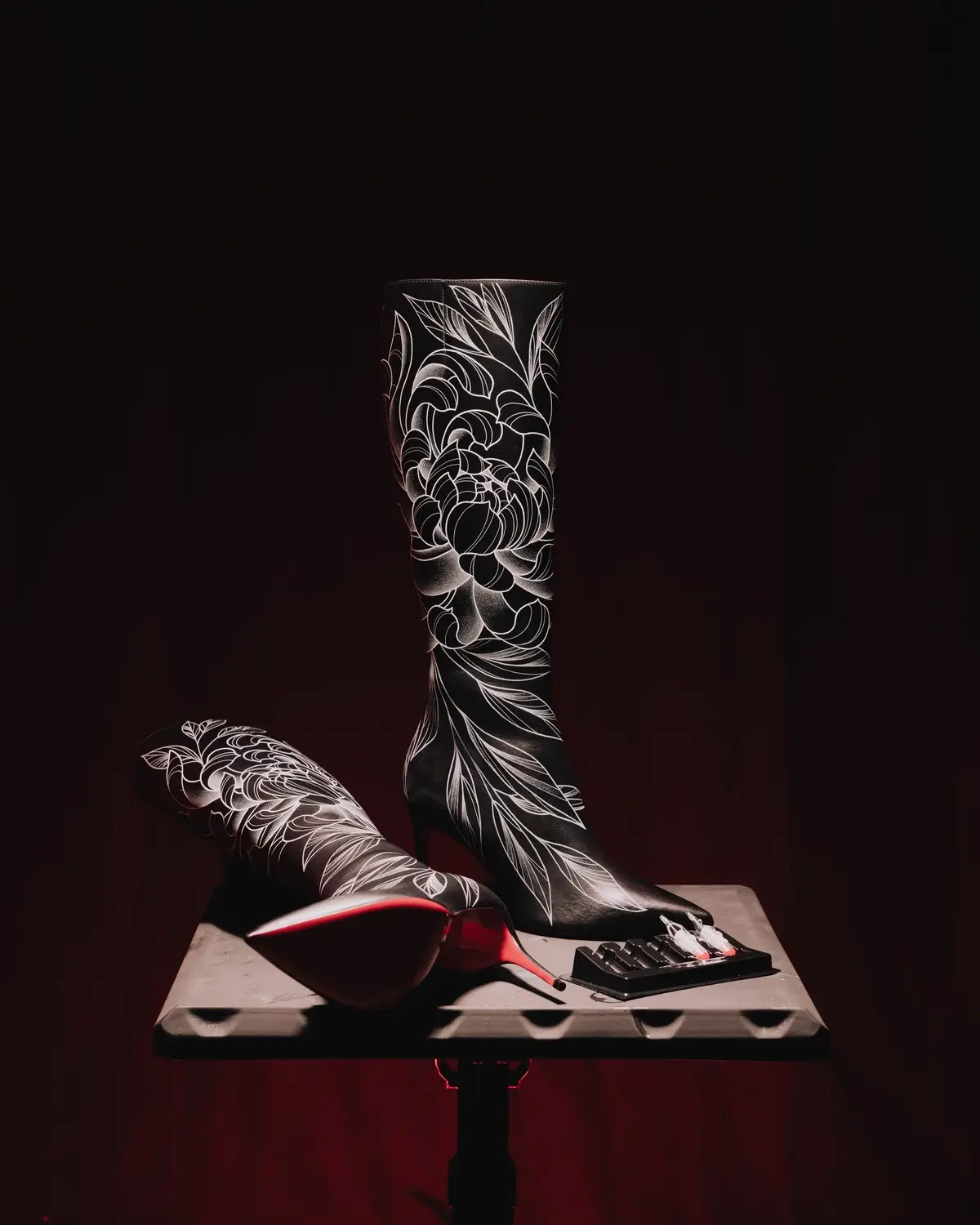
With no precedent to follow nor experts to call, Alcock built the process from nothing, alone, in a shed behind his house. “There was no avenue to go and talk to anyone about it,” he explains. “I have to do a trial. I have to make an error. I have to break machines, break needles, ruin shoes, spend the money, spend the time.”
He shares that he spent six to eight months in that shed “like an OCD, ADHD kid, hyper focused, solving problems every day,” before the process stuck. The real proof came when a finished piece survived an intense stress test over time. He had found a way to make leather look tattooed and a way to make it stay.
LINE OF WORK
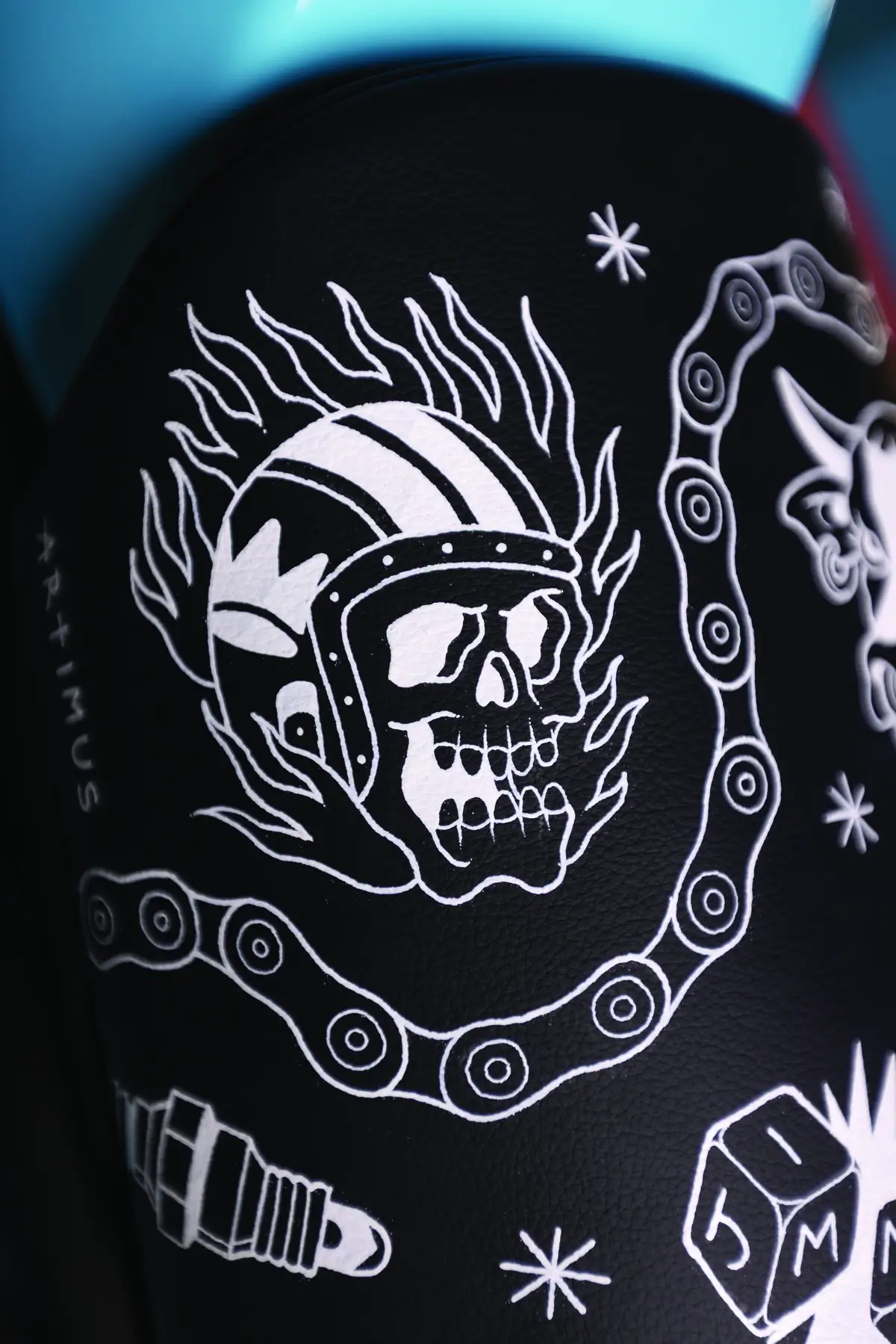
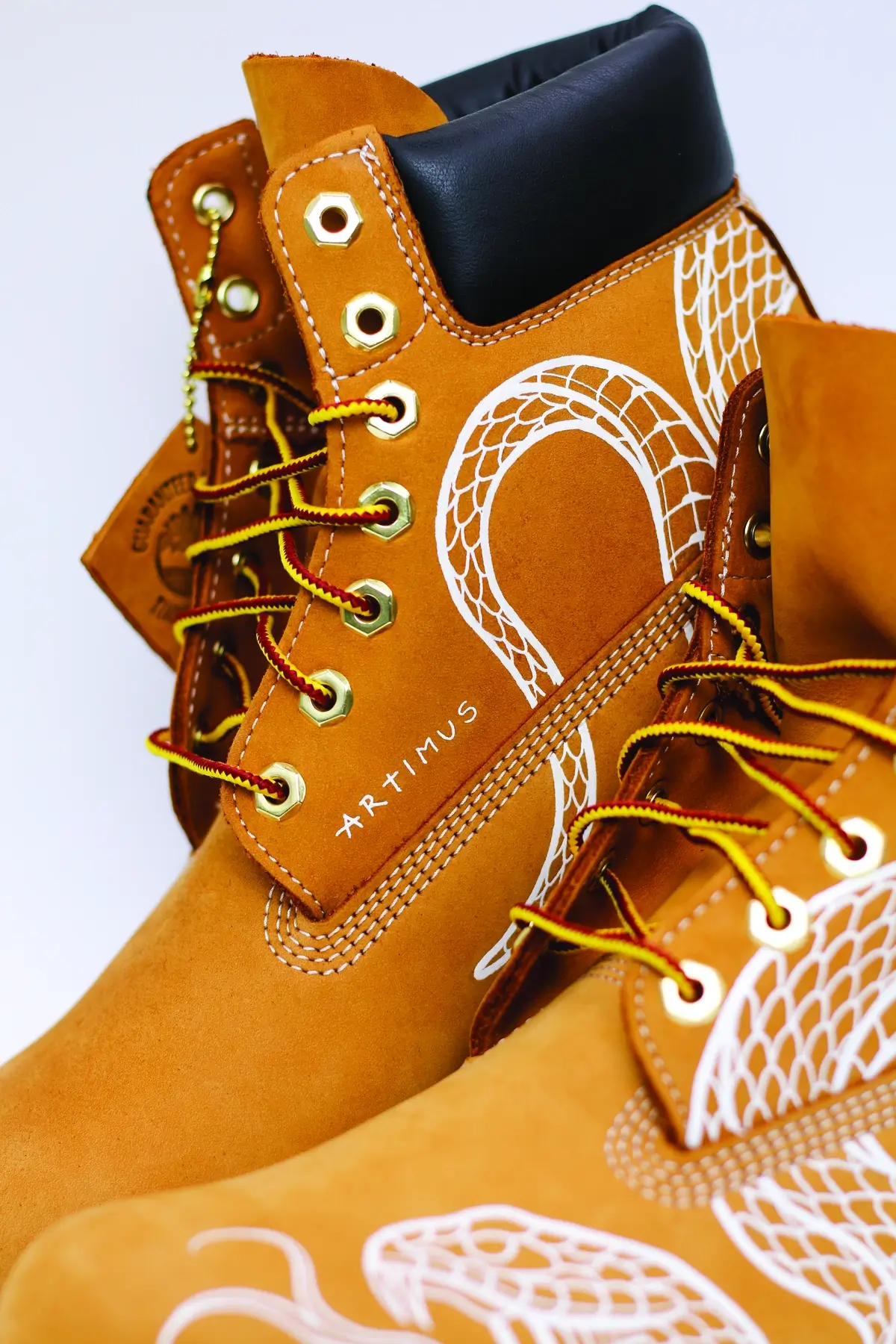
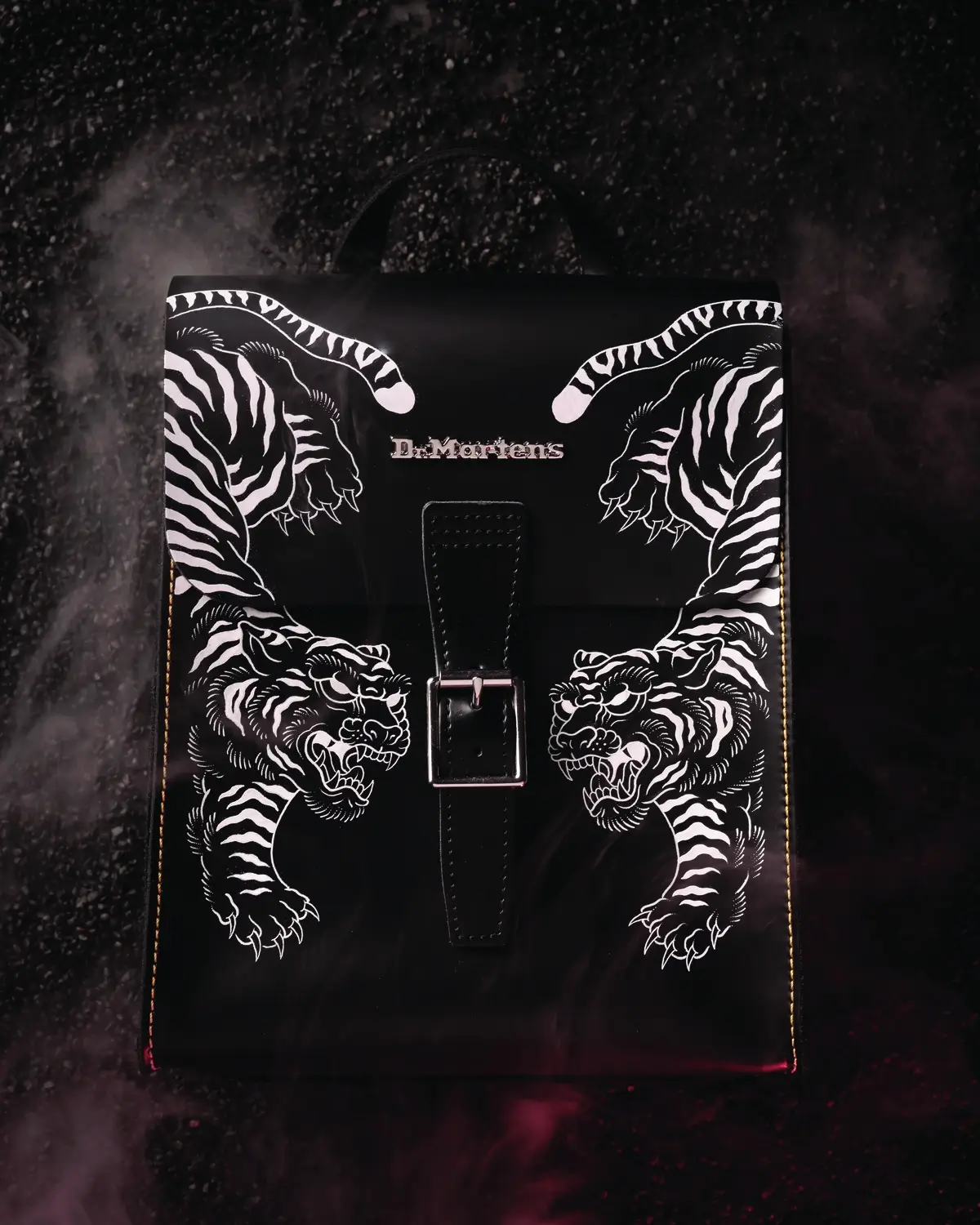
The aesthetic that emerged from that process looked nothing like his earlier work. On skin, Alcock gravitated toward dense, high-contrast gothic imagery and Japanese-style tattooing. Leather demanded the opposite. “Rather than adding all this shading and doing all these other things, I realized that actually clean linework stands out more,” he says. Bold, uncomplicated linework on leather reads clearly on a shoe from 20 feet away, without the saturation his earlier style depended on. “It was a really weird change, but I had to adapt to the medium that I was working on.”
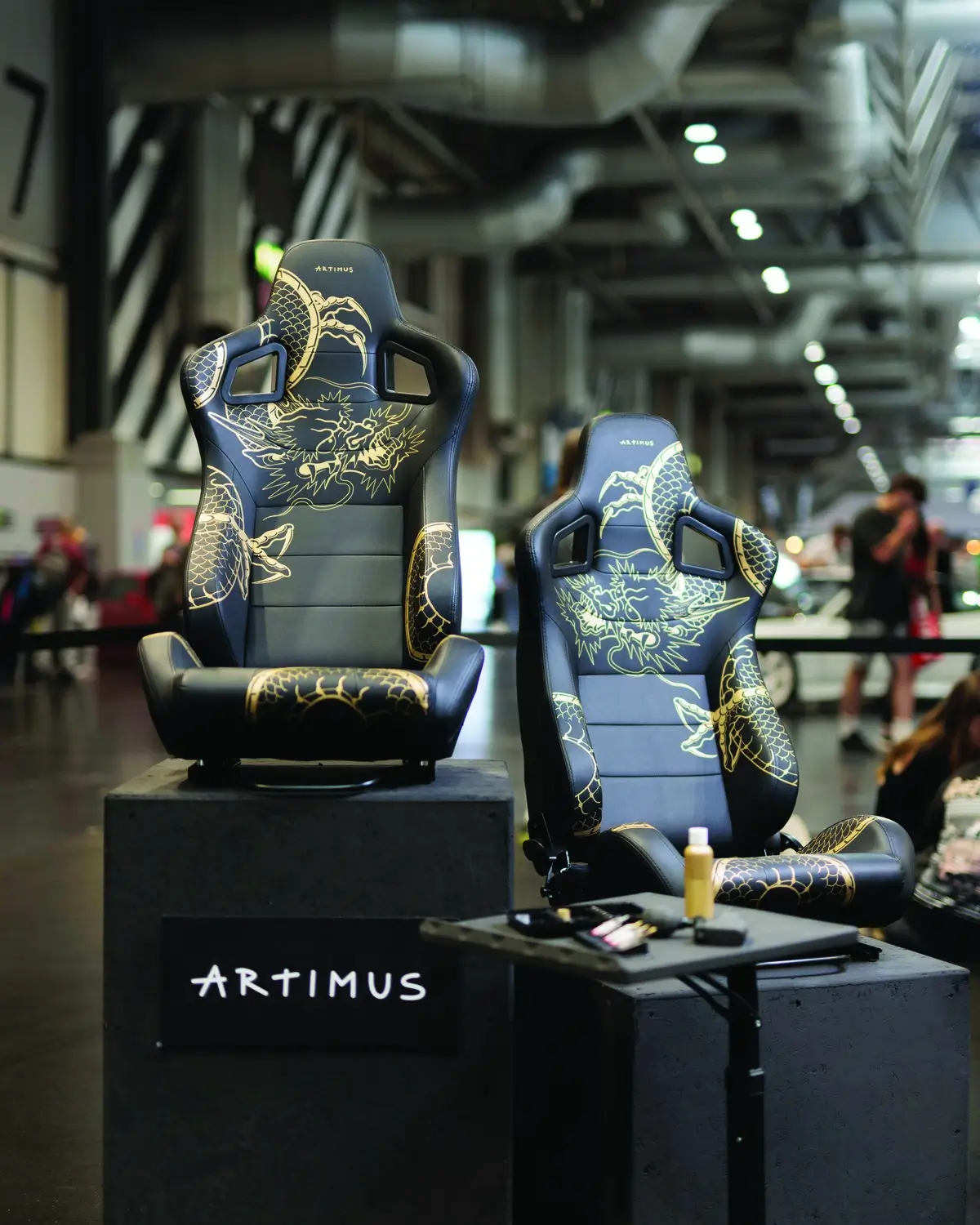
That restraint has become its own kind of signature. Snakes, dragons, and floral motifs recur across his pieces, not because his range is limited, but because a recognizable line does more for a brand than a technically harder one. “You know when you see my linework, that’s me,” he says, likening it to a logo. The long, curving lines suit the leather’s demands, too: a snake or dragon can wrap a form the way a shoe or seat curves, which he describes simply as “easy coverage.”
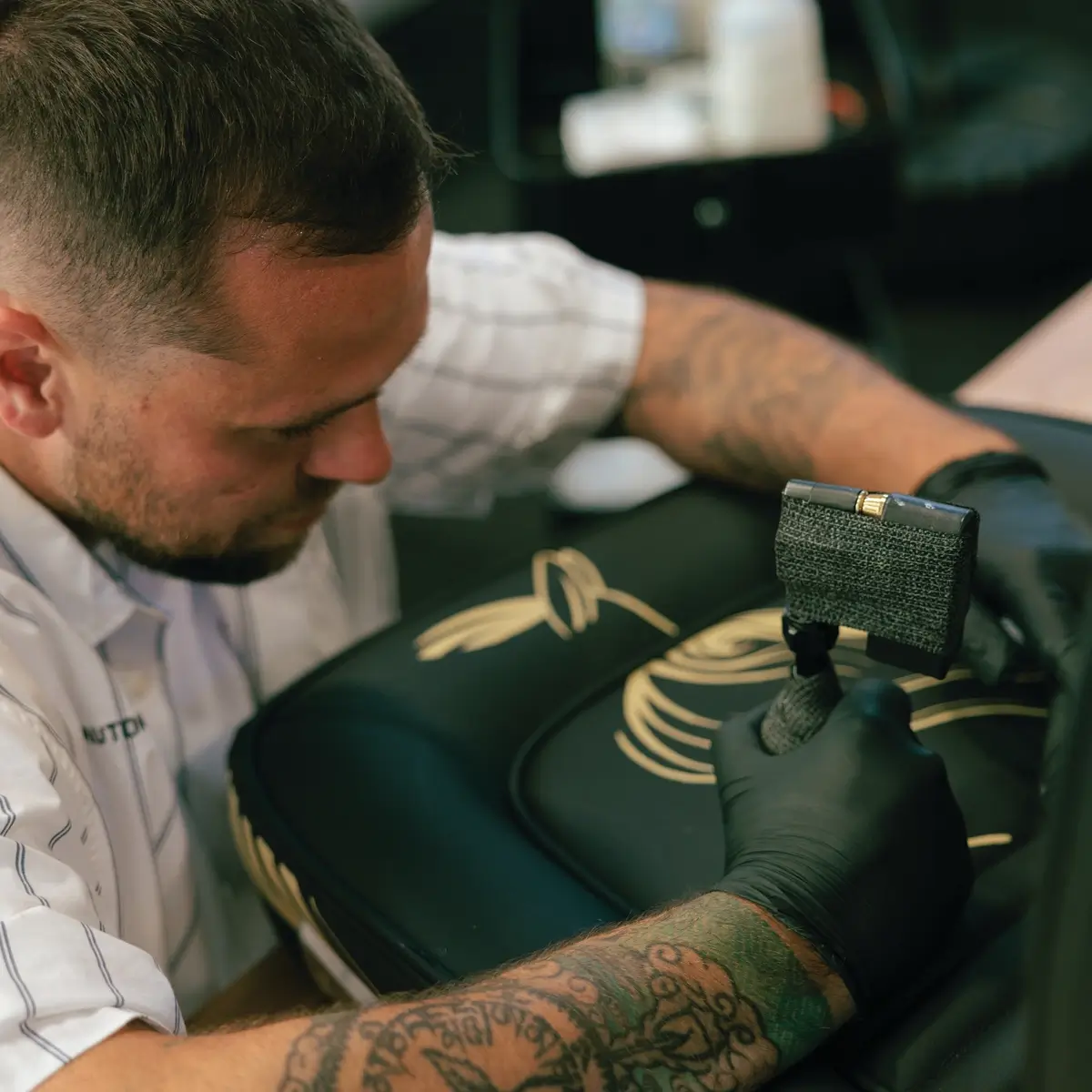
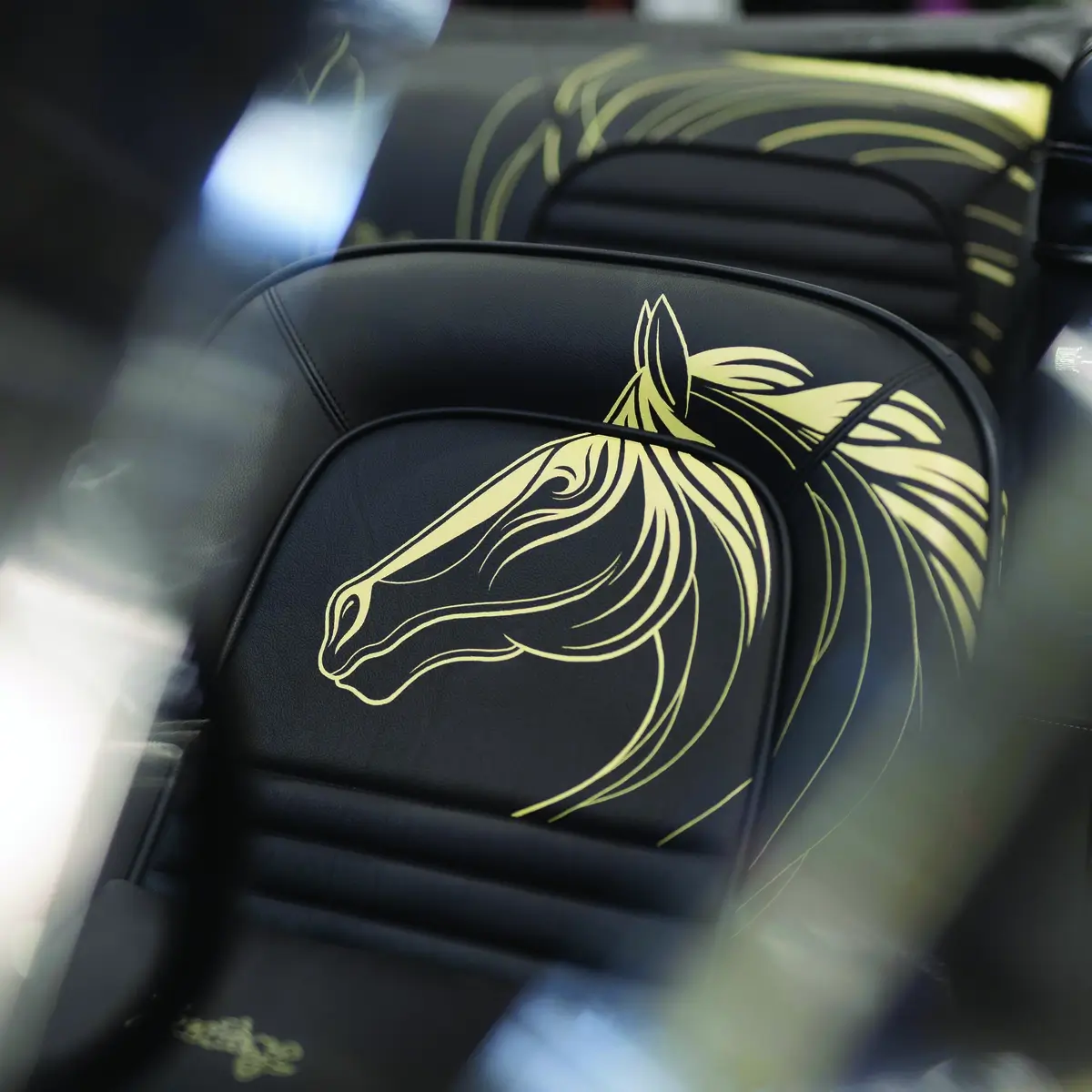
As he refined his leather-shoe tattooing technique, he realized there was no limit to what he could ink. Shoes remain central to his limited-edition model — small numbered runs, handmade and sold directly — but his pioneering technique has since moved into automotive interiors, furniture, and branded partnerships once unthinkable for a “traditional” tattoo artist.
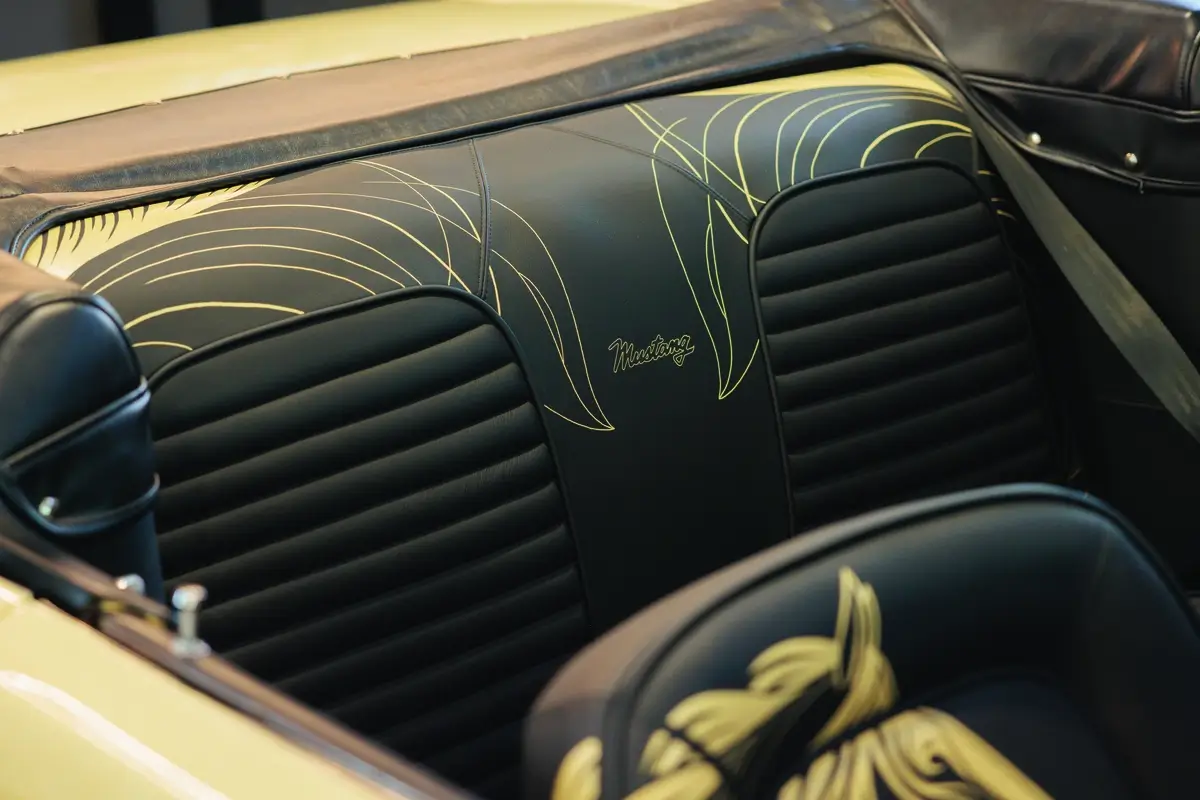
He tattooed the seats of a Porsche GT3 and built an entire leather canvas from rawhide for a year-long global contract with Monster Energy. He’s activated in-store with Birkenstock, put a permanent design on a Jimmy’s Iced Coffee can sold worldwide, and inked the full interior of a 1966 Mustang, winning Best Interior at Gravity Show, one of Europe’s largest custom car shows, on his first appearance. He’s currently in talks with Mazda, Jaguar, Land Rover, and Porsche, after his tattooed leather samples passed 50-year stress tests for UV damage and abrasion.
“Once you cut that human being out, tattoo artists now have an avenue into luxury fashion, design and homeware, the automotive space,” Alcock says. “There quite literally are limitless possibilities for artists to really expand their life outside of a tattoo studio.”
GIVING BACK THE BLUEPRINT
For an artist who built his leather-tattooing process alone, Alcock is direct about not wanting others to repeat that isolation. He credits a tattooer he trained under, Gino Dartnall, with the belief that shaped his own legacy: real change in this industry comes not from client work, but from what an artist gives back. “I truly believe I have given something to the industry that is hands down bigger than myself,” he says.
In practice, that meant publishing his process rather than sitting on it. Alcock offers a step-by-step e-book and a video masterclass covering leather stencils, machine configuration, ink selection, and which leathers actually hold a tattoo. He’s kept both deliberately inexpensive, even as he weighs how long that pricing can hold before the market oversaturates. “I’m making it cheaper than I should do because I do believe that the industry needs more artists,” he says.
The instinct traces back to his own view of opportunity as a kid. The only in-person teaching he does is unpaid, reserved for kids without access to apprenticeships or financial support — kids, he says, who remind him of himself. “These are kids that just don’t have a lot of chances,” he says. “I’ve always made sure I teach them.”
Two years ago, Alcock was an unknown tattoo artist coming off a decade of client work that he says he feels went nowhere. “I spent the effort to quite literally reinvent this craft to forward an industry,” he says. Today he’s signed with a global energy drink brand, courting three car manufacturers, and building a limited-edition business model designed to be replicated by other artists chasing their own way out of an oversaturated industry.
With change comes opportunity, and Alcock’s focus on leather was a risky endeavor that is paying tangible dividends and, more importantly, demonstrating to fellow tattoo artists that they too can flourish with a little flexibility.
Editor's Picks
The Ink That Heals: Inside Veteran Ink’s Mission to Help Heroes Through Art
For many veterans, tattoos are more than body art—they’re a way to process pain, honor service, and remember the stories that shaped them.
Reka Nyari – Body Language
Reka Nyari captures powerful portraits of tattooed individuals, blending storytelling, art, and raw human expression through her lens.
More From Culture
Steel to Sole
October 19, 2026
Your Books Got Busy. Your Software Didn’t.
October 19, 2026
Halloween Essentials to Die For
October 14, 2026
It’s Shnow Season!
October 13, 2026